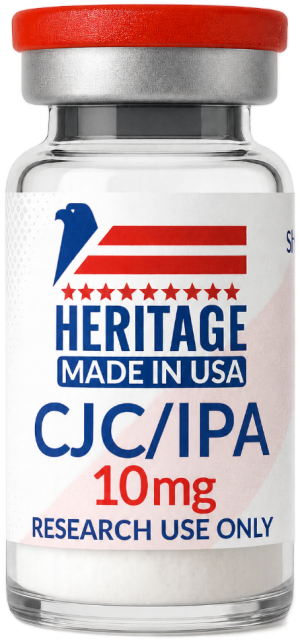
CJC-1295 / Ipamorelin 10mg
Dual peptide blend: CJC-1295 No DAC (5mg) + Ipamorelin (5mg) — two distinct GH-axis receptor targets GHRH receptor analog paired with selective GHS-R (ghrelin receptor) agonist Research-grade For in vitro dual-mechanism research only
For laboratory research use only. Not for human or veterinary consumption. SKU CP10.
Product details.
CJC-1295 (Without DAC) — Molecular Profile
CJC-1295 without Drug Affinity Complex (also referred to as Modified GRF 1-29 or Mod GRF 1-29) is a synthetic analog of growth hormone-releasing hormone (GHRH). The peptide consists of 29 amino acids with the sequence: Tyr-D-Ala-Asp-Ala-Ile-Phe-Thr-Gln-Ser-Tyr-Arg-Lys-Val-Leu-Ala-Gln-Leu-Ser-Ala-Arg-Lys-Leu-Leu-Gln-Asp-Ile-Leu-Ser-Arg-NH2. It has a molecular formula of C152H252N44O42 and a molecular weight of approximately 3,367.97 Da. The “without DAC” designation is important. The original CJC-1295 formulation incorporated a Drug Affinity Complex — a maleimido derivative of lysine that binds covalently to serum albumin, dramatically extending its circulating half-life. The non-DAC version used in this blend lacks that modification, resulting in a shorter-acting compound with a half-life measured in minutes rather than days. This distinction is significant in research design, as the two versions produce fundamentally different pharmacokinetic profiles. CJC-1295 has been the subject of multiple peer-reviewed publications. Teichman et al. (2006) published a study in the Journal of Clinical Endocrinology & Metabolism characterizing the pharmacokinetics of the DAC-conjugated version. Alba et al. (2006) reported on growth hormone responses in a clinical study published in the same journal. The non-DAC variant has been widely used in preclinical research as a tool compound for studying the GHRH receptor signaling pathway.
Ipamorelin — Molecular Profile
Ipamorelin is a synthetic pentapeptide (five amino acids) with the sequence: Aib-His-D-2-Nal-D-Phe-Lys-NH2. Its molecular formula is C38H49N9O5 and its molecular weight is approximately 711.85 Da. The peptide was first described by Raun et al. (1998) in a publication in the European Journal of Endocrinology, where it was characterized as a selective growth hormone secretagogue receptor (GHS-R) agonist. Ipamorelin is notable in the research literature for its selectivity. Unlike earlier GHS-R agonists such as GHRP-6 and GHRP-2, Ipamorelin was reported by Raun et al. to produce growth hormone release without significantly affecting cortisol or prolactin levels at comparable concentrations. This selectivity profile has made it a widely used reference compound in studies investigating GHS-R signaling specificity. Anderson et al. (2001) further characterized its selectivity profile in a study published in the European Journal of Endocrinology.
The Blend Rationale
The combination of a GHRH analog (CJC-1295) and a GHS-R agonist (Ipamorelin) in a single preparation reflects a research paradigm that has been explored extensively in the literature. These two peptides act through different receptor pathways — GHRH receptor and GHS-R1a, respectively — which has made their combination a standard tool in studies investigating synergistic signaling at the hypothalamic-pituitary axis. The 1:1 mass ratio (5 mg:5 mg) is the most commonly referenced combination in the research peptide literature. Providing both compounds pre-blended in a single lyophilized vial eliminates the technical challenges of combining two separately reconstituted peptides — volume matching, concentration calculation for mixtures, and the risk of contamination during transfer between vials. The blend dissolves as a single preparation, producing a solution that contains both compounds at known concentrations.
Reconstitution and Handling
Reconstitute with bacteriostatic water by injecting the solvent slowly along the inside wall of the vial. Do not inject directly onto the lyophilized powder. Swirl gently until completely dissolved — the solution should be clear and colorless. A common reconstitution volume is 2 mL of bacteriostatic water, yielding a concentration of 2,500 mcg/mL of each peptide component (5,000 mcg/mL total). See the Heritage Labs Reconstitution Guide for the complete protocol and concentration calculations.
Storage Recommendations
Store the lyophilized vial at -20°C (freezer) for long-term stability of 2 or more years, or at 2-8°C (refrigerator) for 6-12 months. Keep sealed in the original vial, protected from light and moisture, until ready to reconstitute. After reconstitution with bacteriostatic water, store at 2-8°C and use within 21-28 days. Do not leave reconstituted solution at room temperature. If freezing reconstituted solution, divide into single-use aliquots first and do not refreeze after thawing.
Available Formats
The CJC-1295/Ipamorelin blend is available at the 5 mg/5 mg concentration. Heritage Labs also carries CJC-1295 and Ipamorelin as individual compounds for researchers who require different ratios or separate administration. The full peptide catalog, along with bacteriostatic water and other reconstitution supplies, is available in the Heritage Labs shop.
Technical reference adapted from the original Heritage Labs USA product listing. This description is not a certificate of analysis or evidence of testing for inventory supplied by this store.