Specifications
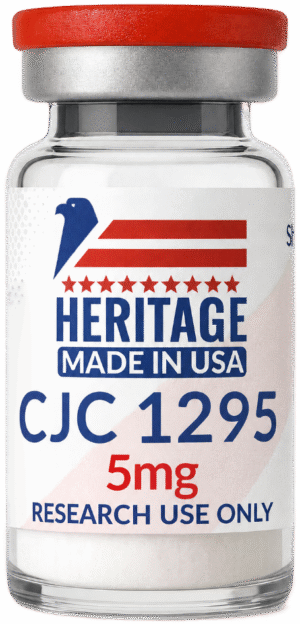
| Sequence | Tyr-D-Ala-Asp-Ala-Ile-Phe-Thr-Gln-Ser-Tyr-Arg-Lys-Val-Leu-Ala-Gln-Leu-Ser-Ala-Arg-Lys-Leu-Leu-Gln-Asp-Ile-Leu-Ser-Arg-NH₂ |
| Amino Acids | 30 |
| Molecular Formula | C152H252N44O42 |
| Molecular Weight | 3367.88 g/mol |
| CAS Number | 863288-34-0 |
| Form | Lyophilized powder |
| Quantity | 5mg per vial |
Mechanism
CJC-1295 binds GHRH receptors on pituitary somatotrophs, triggering adenylate cyclase, cAMP accumulation, PKA phosphorylation, and growth hormone vesicle release. The non-DAC form preserves pulsatile GH secretion patterns — closer to what endogenous GHRH produces — while the DAC version creates sustained, multi-day elevation. Published clinical data documents GH increases of 70-107% with IGF-1 elevations around 28% over 16-week observation periods (Khorram et al., JCEM, 1997; PubMed 9141541).
No DAC vs with DAC
The Drug Affinity Complex is a maleimidopropionic acid derivative that covalently binds serum albumin. With it: half-life jumps to 6-8 days, GH stays elevated constantly. Without it: half-life stays at 30 minutes to 2 hours, GH pulses naturally. Different tools for different research questions. Both available from Heritage Labs USA.
CJC-1295 + Ipamorelin
These two target different arms of the GH axis — GHRH receptor vs GHS-R (ghrelin receptor). Preclinical protocols routinely pair them to study dual-pathway somatotroph activation. The CJC-IPA blend combines both in a single vial.
Research applications
- GHRH receptor binding kinetics and profiling
- Peptide stability analysis under buffered conditions
- Comparative GHRH analog studies (vs Sermorelin, Tesamorelin)
- GH pulsatility and secretion pattern research
- Dual-pathway studies when paired with GHS-R agonists
Frequently paired with
- Ipamorelin 5mg — Also available as CJC-IPA Blend.
- AOD-9604 5mg — Body composition research.
Storage
- Lyophilized: -20°C
- Reconstituted: 2-8°C, use within 30 days
- Protection: Shield from light and moisture; avoid freeze-thaw cycles
References
- Clark RG, Robinson ICAF. Nature. 1985;314(6008):281-283. PubMed 2858818
- Khorram O, et al. J Clin Endocrinol Metab. 1997;82(5):1472-1479. PubMed 9141541
- Martin B, et al. Neuromolecular Medicine. 2005;7(1-2):3-36.
- Sinha DK, et al. Transl Androl Urol. 2020;9(Suppl 2):S149-S159. PMC7108996
For laboratory research use only. Not for human or veterinary use.
Technical reference adapted from the original Heritage Labs USA product listing. This description is not a certificate of analysis or evidence of testing for inventory supplied by this store.